Saturday, 11 January 2014


'I am not at all in a humour for writing; I must write on till I am.' 
-Jane Austen in Personal Correspondence

Friday, 10 January 2014

Wait For Me!


Continuing on the Mitford theme, I'm pretty chuffed that Debo's memoir has finally made into my collection! Review to follow shortly, no doubt. 

Nancy Mitford, Highland Fling & First Book Review of 2014


I am utterly devoted to the divine Nancy Mitford, although I've only read her post-War novels The Pursuit of Love, Love in a Cold Climate and The Blessing. I'd never read any of her earlier novels, and I suppose I had come to accept the general consensus which seems to do the rounds which is that they're just not that good. How has this come to be accepted when Highland Fling turned out to be an utter delight?! I thought maybe the earlier novels focused more on plot and characters and lacked substance. Whereas there is definitely a focus on the Bright Young Things of the 20s and 30s, there are still some beautiful little snippets of Mitford gold which cannot help but shine through. I've laughed out loud continuously, and who wouldn't when faced with passages like this: 
'He was doomed to immediate disappointment, finding that besides being an unusually stupid woman she had less sex appeal than the average cauliflower; and when, in the course of conversation, he learnt that her two children were called Wendy and Christopher Robin, his last hope of being charmed vanished for ever.' 
Comic genius.  
 

Wednesday, 1 January 2014

2014

Oh lordy. A new year has snuck up on me and I haven't updated this blog in months. New Years Resolution #348: get back into the habit of making book review posts again. And what better motivation than to start a new reading challenge! I am very excited about this one- The 50 States Reading Challenge posted by Somerset Books. All you need to do is read as many books as you can by American authors born in different states! I've already got a head start because of my 'Cities in American Literature' module. First up, it's Sister Carrie by Theodore Dreiser, who was born in Indiana. One down, forty-nine more to go...

Thursday, 4 July 2013

Cold Comfort Farm

“One of the disadvantages of almost universal education was the fact that all kinds of persons acquired a familiarity with one’s favourite writers. It gave one a curious feeling; it was like seeing a drunken stranger wrapped in one’s dressing-gown.”

Interestingly, (or not, as the case may be you sassy reader) this is not the first book by Stella Gibbon's I've read. Despite Cold Comfort being undeniably her most well-known novel, I came across a newly re-issued copy of Westwood in Waterstones and immediately bought it. Now, this is most irregular for me for a number of reasons:

  1. I almost exclusively buy second-hand books, because I am a poor student who is addicted to charity shops. 
  2. I knew absolutely nothing about Stella Gibbons or Cold Comfort or Westwood yet I bought it anyway. Usually I'd buy a book because it's on a 'to-read' list or I know at least a little about the author. I know, how dangerously feckless of me. 
I've never regretted the decision thankfully because Westwood was a cracking read. 
Imagine a Jane Austen novel that's set in London during the second world war and you'll arrive at Westwood. So, getting back to Cold Comfort Farm for the present...

The story is about a young woman called Flora Poster who is left orphaned and impoverished and so makes the decision to live at some relatives farm whom she has never me before in her life. A bold move I would say. Flora then sets about to reorganise the lives of her new foster family all with the help of some common sense and good humour. Flora genuinely isn't as irritating as she sounds; I'd say she was a fearsome combination of Emma Woodhouse and Elizabeth Bennet and I for one want to be her. It is a very funny read, and quite clearly mocks the work of Thomas Hardy and the Bronte sisters (especially Wuthering Heights). Have you ever read a Victorian novel of hopelessness and wanted to grab one of the particularily fatalistic characters by the lapels and shouted: 'GET A GRIP!'. This is what Flora does and my god is it satisfying. Now, I would like to point out that I am huge fan of Thomas Hardy and admire Wuthering Heights enormously, but Stella Gibbons' tongue-in-cheek treatment of such novels made it hard to not to chuckle. 
All in all a peculiarly satisfying read. Although, one thing that I have noticed about Gibbons' protagonists is that it seems as if she doesn't really care for them herself. Jane Austen's novels are so beguiling because even when her characters have some undesirable qualities, they are ultimately loveable and loved by Austen. I feel that this is the only thing which holds me back from full-blown raptures of Gibbons' work.  

Losing Weight the Literary Way...

Shoddy camera-phone picture from my ramble in the Worcestershire countryside. 


Went for my first audio-book walk today! I stole the idea from Stephen Fry, who lost a load of weight just by walking everyday whilst listening to an audio-book. It was nice because you just get lost in the story and forget how long you have been walking for. I started with Bleak House by Charles Dickens, I’ve been fancying a bit of Dickens for a while now but I haven’t had much time to settle down with a hefty tome like Bleak House. Think i’ve settled on the perfect compromise… :)

Tuesday, 2 July 2013

The Pursuit of Love.

   "Louisa said to me, her eyes as big as saucers: 'He rushes into her  room before tea and lives with her.' Louisa always describes the act of love as living with. 'Before tea, Fanny, can you imagine it?'"


I have meant to read The Pursuit of Love for so very long. Ever since I read The Mitford Girls by Mary S. Lovell which kept me hooked on the antics of Nancy, Pamela, Diana, Unity, Decca and Debo for the entirety of the Christmas break. The whole family, quite frankly, rock my socks.  I'm still toying with the idea of writing my dissertation on the novels of Nancy Mitford and Jane Austen, but we will see. I am glad to report that this novel was entirely heavenly. Uncle Matthew (thinly masquerading as Mitford's father Lord Redesdale) is a joy: 'This violent, uncontrolled man, like his children, knew no middle course, he either loved or he hated, and generally, it must be said, he hated.' Probably my favourite character in the book to be honest. Although I am glad that I only met this particular tyrant in the pages of a book; I fear I would have been denounced as a 'sewer' and roundly loathed. The sanity of the narrator, Fanny, perfectly acts as a conduit for the madness of the Radlett family and our heroine Linda. Being a terribly awkward being myself, I could not help but marvel at the carefree, self-assured confidence of Linda. Unfortunately I felt the ending was a little rushed. Or perhaps I was more disappointed with the unexpectedly sad conclusion from an otherwise sparkling read. Certainly more bittter-sweet than I had anticipated, but no less enjoyable. 

Sunday, 30 June 2013

Jane Austen, Feminism and Fiction

This is a must read for any Janeite. What I loved most about this book was how it places Austen squarely in the midst of her radical female contemporaries and predecessors, and it gives Jane back her mantle of 'feminist'. Although by today's standards the feminism involved seems rather tame and out-dated, it is there nonetheless. It also debunks a lot of the 'good Aunt Jane' myths which were created by relatives in the Victorian age, or at least provides an alternative viewpoint. Most importantly it's a nice reminder that we actually know very little about her life, and so excepting conclusions like 'Jane hated Bath' (a theory which is based on the evidence of three letters) is rather rash and unhelpful. The lack of letters from this period has long been attributed to their contents being of an intimate, romantic nature; hence their destruction. However, Kirkham suggests that Jane's period in Bath was a lot more socially and intellectually active than we have been led to believe, for it is 'the one period Austen spent continuously in an urban environment, in contact with a society and culture close to the metropolitan'.  There's a good chance she saw many plays, wrote about her opinions on these plays and notable figures she may have met and just generally broadened her literary horizons, yet in Edward Austen-Leigh's 'Memoir' this time is Bath is merely talked of as a time when she 'went a good deal in society, in a quiet way, chiefly with ladies'. As Kirkham remarks, this is a 'masterly dismissal of five vital years in the author's life in such a way as to inhibit further interest in them'.

'It will not do to approach the female authors of this period and divide them into genuine feminists versus the rest, for at this period to become an author was, in itself, a feminist act.' p.33.
Anyway, theories abound and I for one find Kirkham's suggestions very persuasive. The rest of the book is full of interesting insights, and I came away with a different view of Jane than when I began reading. Even if that is only to be slightly more skeptical of Austen myths which have almost become accepted as fact. 

Wednesday, 26 June 2013

The Fry Chronicles

'The Fry Chronicles' covers Stephen Fry's Cambridge University years where he met the likes of Hugh Laurie and Emma Thompson and goes on to describe his first tentative steps into the world of show-business. I have to admit now that I am big fan of Stephen Fry. I watch QI religiously and wrote an essay on his US travels and his book 'Stephen Fry in America' at University. In short, I adore the man. No doubt I was expecting great things and I can honestly say I was not disappointed; it has everything that you could wish for in an autobiography; warmth, humour, sadness and the brilliancy of a life rendered with honesty. 

'Incuriosity is the oddest and most foolish failing there is.' p.87

Also I actually found the book to be unexpectedly inspirational. Reading about over-achievers like Mr Fry always makes me want to get up off my arse and do something with my life. When he describes Cambridge for instance, it made me wish that I had the intelligence and means to go to Oxbridge. I know it's only a place and I'm getting a perfectly good degree in Winchester but...oh, to feel a part of all that history! To walk the same halls as Wilde and Forster and Holtby and too many other artists and writers to name. It feels as if it really must be something. I loved reading about his student life the most I think, it reminded me to enjoy my own student days whilst I have the chance. I only have one year left, and I want to squeeze every last ounce of happiness out but the real world comes for me. It is truly a marvelous book, and the vocabulary is breathtaking so read it with a dictionary close at hand... In short, I adored this book because it is probably the closest I will ever get to sitting down and having a good 'ol chinwag with Stephen Fry. 

Tuesday, 25 June 2013

Cider With Rosie


'Cider with Rosie' was, for me, one of the most evocative books I have ever read. The book is about Laurie Lee's youth in a rural Gloucestershire village after the First World War. Lee recounts a bygone age, where the rural classes were still at the mercy of the seasons and of local superstitions. It is a book of homemade wines, languid summers and rural poverty. You are entirely drawn into the novel from the start by the incredibly insular surroundings of the cramped cottage and the Cotswold valley in which the village sits. 
'Summer, June Summer,with the green back on earth and the whole world unlocked and seething- like winter, it came suddenly and one knew it in bed, almost before waking up; with cuckoos and pigeons hollowing the woods since daylight and the chirping of tits in the pear-blossom.' 
The novel is an unrestrained feast for the senses but it is not this alone which charmed me. I live in Worcestershire, a county in Britain which neighbours Gloucestershire and so, inevitably, there was much in the 'Cider with Rosie' which resonated with me. Being awoken my birdsong from May til August, apple-green spring and unrelenting July sunshine where, it seemed, absolutely nothing seemed to happen but summer. It was not only an ode to the countryside though; there was so much of life, death, youth and age to be found too. A vivid recollection of a way of life largely unknown to us now. 

Saturday, 22 June 2013

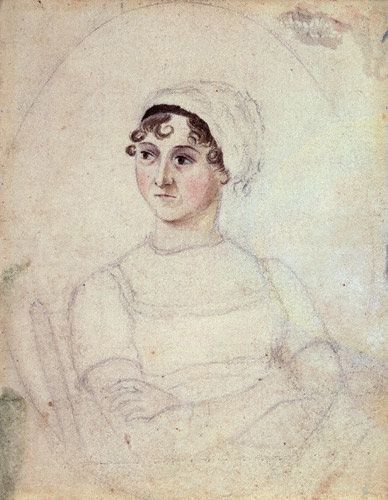
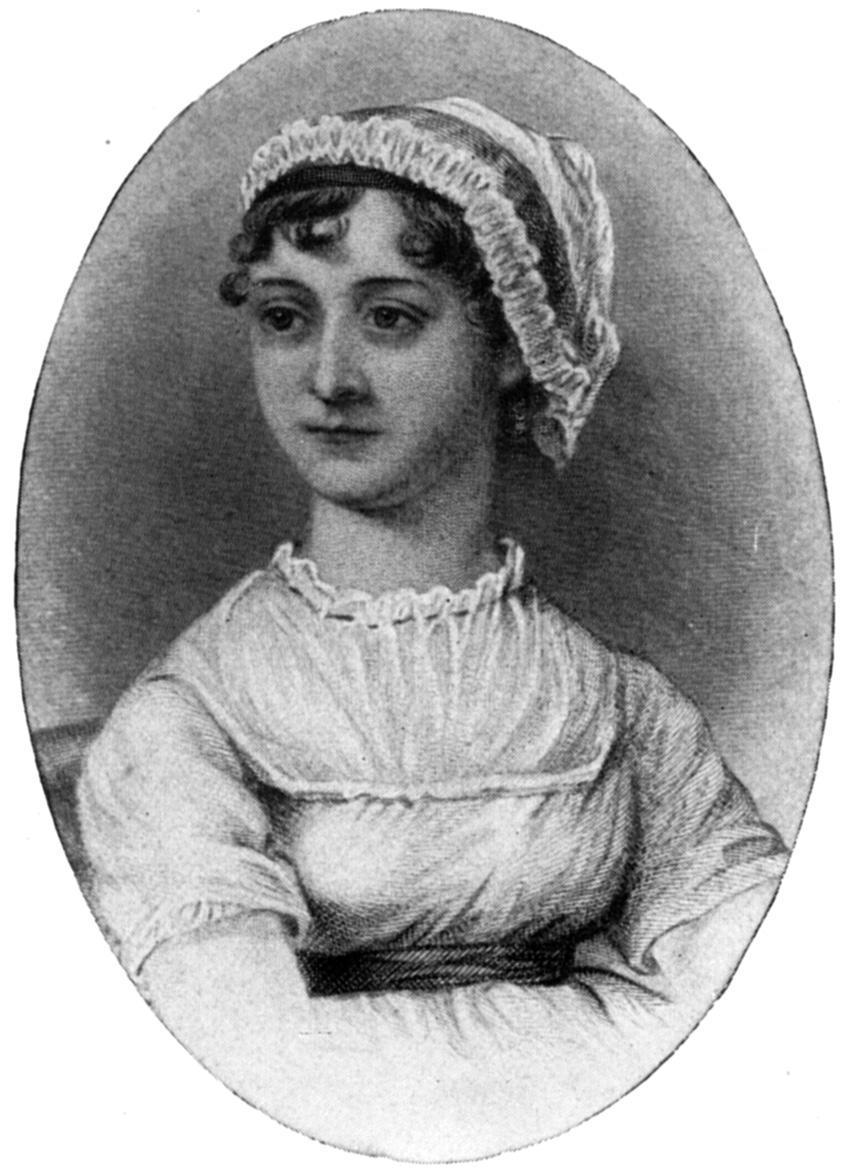
The Irreconcilable Faces of Jane Austen.

‘Two portraits of Jane Austen are reproduced as the frontispiece to this book. The top one, drawn by Cassandra when both were still young, is the only authentic portrait known. It shows a young woman with penetrating dark eyes, sitting with arms rather aggressively crossed and staring boldly ahead. The mouth is caustic, and there is no more than the suspicion of a smile; the curls are slightly absurd. The subject is plainly attired and sits on what appears to be a simple, country-made, ladder-back chair. The lower portrait is the one commissioned for the Memoir, and executed by Mr Andrews of Maidenhead, on the basis of Cassandra’s unacceptable sketch and the advice of the now elderly relations, who told him what their recollection of the appearance of the author was, as they saw her more than half a century earlier. Mr Andrew’s Jane Austen is altogether more decorous than Cassandra’s. The face is no longer slightly alarming, the cap and curls are prettier, the pose is more ladylike and the chair would belong comfortably in a Victorian dining room. The dress is right for the turn of the century, but this is a Victorian lady, dressed up in the fashion of another age, who could not have read Mary Wollstonecraft or sympathised with some of her ideas, although the young woman of Cassandra’s sketch looks as though she might.’
-Margaret Kirkham, Jane Austen, Feminism and Fiction (1997)
I’ve always found it difficult to reconcile the Memoir portrait with the witty, sardonic authorial voice of her writing. It’s a shame that the latter portrait is the most widely reproduced and recognised likeness of Jane. I for one much prefer Cassandra’s original portrait. The folded arms and almost impatient look are somehow more appealing than it’s wide-eyed Victorian counterpart. 

Wednesday, 19 June 2013

I Step Once More Into the Fray...

So, I was just perusing the bookshelves in a local Oxfam charity shop (nothing new there) when I  spotted a notice asking for a 'book worm' to volunteer to sort and price books! Well how could I walk past a notice like that? During term time at University I volunteer at an Oxfam, but mainly sorting donations and working the till so I never have the opportunity to get my hands on very many books. I'm still job-hunting for a paid vacancy in a shop or something, but this is too good an opportunity to miss! I'll be gaining experience, meeting new people and spending all day around second-hand books. Utter, utter bliss. The only cause for concern is that I may end up buying more books than I'm selling...but even so it's for a good cause so, roll on Monday and my first day!

Jasmine x

Tuesday, 18 June 2013

The Painted Veil

So far, this summer seems to have been all about reading new authors for the first time and this  one was no different. This is an engrossing narrative which throws you straight into the midst of an extra-marital affair and an emotionally manipulative husband who sets out to punish his wife for her indiscretion. Published in 1925, it caused a storm on it's release with it's honest portrayal of adultery and a bored and unfulfilled wife. But from the perspective of a modern reader, it is not the adultery which has the ability to shock, but rather the fall out from the affair. 


"Some of us look for the Way in opium and some in God, some of us in whisky and some in love. It is all the same Way and it leads nowhither."
Kitty Fane's husband, Walter, is a biologist and when he is offered the opportunity to work in an area of China ravaged by cholera, he accepts. With no where else to go, Kitty soon realises that she has to go with him and to almost certain death. Needless to say I could not put this novel down once I had started, and I longed to know what the cold and remote Walter had planned next. The portrayal of Kitty is outstanding; it is so rare to find a male novelist who can paint the machinations of a woman's mind with any degree of accuracy, but he does. Death looms large throughout the novel, and Maugham presents a husband and wife who are both curiously resigned to their own demise.  Neither character are particularly likeable but it doesn't really matter for the original and absorbing story carries you through until the very last page. 

Friday, 7 June 2013

The Diary of a Nobody


This is such a fun little read! It was originally published as a serial in Punch magazine in 1892 and despite it's short length it is a masterpiece of comic brevity. Precisely nothing out of the ordinary happens to Mr. Charles Pooter, its the turn of phrase which he uses which had me chuckling to myself. Mr Pooter is so absurdly banal as to call him a characterisation of genius worthy of Dickens himself. I'll leave you with a particularly hilarious extract from the text to give a flavour of the style. Whether we like it or not, we are all a little Pooter. 


“Gowing began his usual sniffing, so, anticipating him, I said: ‘You’re not going to complain of the smell of paint again?’ He said: ‘No, not this time; but I’ll tell you what, I distinctly smell dry rot.’ I don’t often make jokes, but I replied: ‘You’re talking a lot of DRY ROT yourself.’ I could not help roaring at this, and Carrie said her sides quite ached with laughter. I never was so immensely tickled by anything I had ever said before. I actually woke up twice during the night, and laughed till the bed shook.”

Sunday, 2 June 2013

A Moveable Feast

I have a confession to make. A Moveable Feast is my first ever foray into the realms of Ernest Hemingway. I know, I know, he is a literary legend and I am a poor excuse for a student of literature for not being familiar with his work. The only excuse I can make is that I'm British, and the only books we are exposed to are almost exclusively from English writers, which I do not dispute is a travesty. 

"all Paris belongs to me and I belong to this notebook and this pencil"

Having no prior conceptions about Hemingway (other than his fleeting incarnation in Midnight in Paris) I really wasn't sure what to expect. The first thing that struck me was the writing style: stripped back, bare, raw and honest. Unimaginable skill must have gone into every sentence. It is just so easy to get lost in little literary flourishes and lose the impact of authorial intention along the way. Once I got grips with Hemingway's style I was lost in the ancient cobbled streets of Paris, with senses alive to the hubbub of a busy Cafe. I hung on every one of Hemingway's words, and I couldn't believe how descriptive the prose was despite the dearth of adjectives. If you aren't sold on the astonishing quality of the prose alone, then the presence of Scott Fitzgerald, James Joyce and Gertrude Stein should convince any lover of modern literature to take up this worthy little volume. Upon reading, do prepare to die to see 1920s Paris through the eyes of Hemingway. 


Like a Glutton at a Feast

I've been reading like a glutton at a feast this week. My 'to read' pile has been steadily building over the last few months and now that I am free I've been devouring all in sight. So, stand-by for some reviews and views on my latest literary escapades. 

Jasmine x

Tuesday, 7 May 2013

Oh the student life.

The sun is shining on merry old England and all I want is to be lay amongst the daisies, reading Nancy Mitford novels and drinking shandy. Instead I am faced a frantic week with a total of five essays to complete. It tires me out to even think of it. It seems as a student that you have nothing to do when the weather is awful and nothing is going on. As soon as there is a whiff of fun or adventures to be had, you cannot see above a three foot tall stack of library books and deadlines enough to make one weep.